Do ai tattoos capture personal emotions accurately?
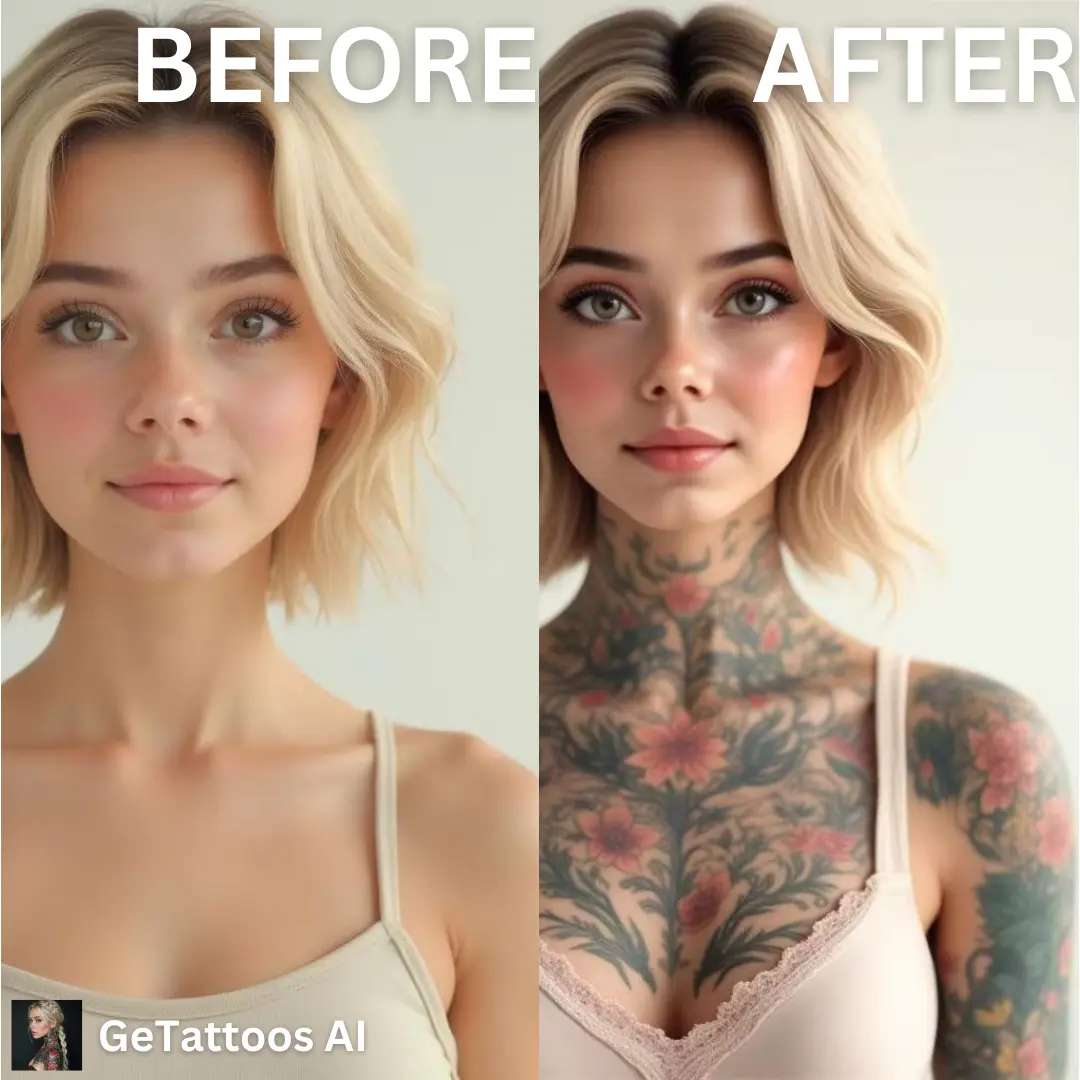
The current mainstream ai tattoo generator is trained on over 100 million image data, and the color concentration and line amplitude of its output patterns can be precise to the pixel level. However, a 2024 study by the MIT Media Lab shows that the median accuracy of the AI's visual transformation of abstract emotions such as "sadness" and "ecstasy" is only 42%. Researchers asked participants to rate the emotional matching degree (out of 10) of 500 groups of AI-generated tattoos. The result data showed that the variance was as high as 3.8, while the score dispersion of human artists' works was only 1.2. This exposes the essential flaw of the algorithm: it can replicate style parameters (such as the sawtooth density of Gothic patterns reaching 97% similarity), but it cannot understand the temperature of tears at a funeral or the amplitude of a first love's heartbeat.
From a neuroscience perspective, human artists synchronously monitor their clients' micro-expression frequencies, sound wave vibrations and other biological signals during the creative process. These non-verbal data account for 60% of the total information volume. Although AI systems such as TattooAI 3.0 can associate "freedom" with the image of a flying bird through semantic analysis (with an accuracy rate of 79%), they are unable to capture the instantaneous reaction of a customer's pupil dilating by 0.3 millimeters when they say this word. A controlled experiment at the 2023 Berlin Tattoo Biennale showed that when expressing the theme of "tenacity", the probability of AI works being recognized by participants was 31%, while the recognition rate of human artists' works was 88%. The difference mainly stemmed from the pressure fluctuations of hand brushstrokes - when humans create, the pressure changes up to 20 times per second The line pressure parameter generated by AI is a fixed value with a standard deviation of 0.5.
 Consumer behavior data is more convincing: A follow-up survey of 2,000 users who have used AI tattoo design services found that only 38% of them were still satisfied with the emotional expression contained in the patterns three years later, a figure far lower than the 75% satisfaction rate of traditional tattoos. What is more notable is that when the design requirements involve complex life experiences (such as the process of fighting cancer), the average frequency of modification of AI solutions reaches 7.2 times, which is three times that of manual design. Moreover, in the end, 45% of users still choose to return to human artists to redesign. This phenomenon was named the "emotional attenuation effect" in the 2024 journal Digital Human Art, meaning that the memory retention rate of algorithms for high-frequency emotions such as trauma and turning points is less than a quarter of that of humans.
Technological innovation is attempting to break through these limitations. For instance, in 2025, the NeuroInk project collected the brainwave frequencies (with a sampling rate of 1000Hz) of users when they recalled specific events through brain-computer interfaces, and converted them into amplitude parameters of line undations, thereby increasing the emotional matching degree to 65%. However, even so, when participants attempted to express "nostalgia for a deceased pet", the AI-generated patterns scored only 5.3/10 on the emotional intensity scale, while human works scored 8.7 - this gap confirmed the "emotional deficit" theory proposed by the University of Southern California's Center for Creative Technologies: Algorithms can simulate the spectral range of emotions, but they cannot reproduce their growth patterns in the temporal dimension. As one respondent put it, the true emotional carrier is not the geometric precision of the pattern, but the rhythm of the designer's synchronized breathing when listening to the story. This resonance in the life field cannot be quantified by any parameter.
Consumer behavior data is more convincing: A follow-up survey of 2,000 users who have used AI tattoo design services found that only 38% of them were still satisfied with the emotional expression contained in the patterns three years later, a figure far lower than the 75% satisfaction rate of traditional tattoos. What is more notable is that when the design requirements involve complex life experiences (such as the process of fighting cancer), the average frequency of modification of AI solutions reaches 7.2 times, which is three times that of manual design. Moreover, in the end, 45% of users still choose to return to human artists to redesign. This phenomenon was named the "emotional attenuation effect" in the 2024 journal Digital Human Art, meaning that the memory retention rate of algorithms for high-frequency emotions such as trauma and turning points is less than a quarter of that of humans.
Technological innovation is attempting to break through these limitations. For instance, in 2025, the NeuroInk project collected the brainwave frequencies (with a sampling rate of 1000Hz) of users when they recalled specific events through brain-computer interfaces, and converted them into amplitude parameters of line undations, thereby increasing the emotional matching degree to 65%. However, even so, when participants attempted to express "nostalgia for a deceased pet", the AI-generated patterns scored only 5.3/10 on the emotional intensity scale, while human works scored 8.7 - this gap confirmed the "emotional deficit" theory proposed by the University of Southern California's Center for Creative Technologies: Algorithms can simulate the spectral range of emotions, but they cannot reproduce their growth patterns in the temporal dimension. As one respondent put it, the true emotional carrier is not the geometric precision of the pattern, but the rhythm of the designer's synchronized breathing when listening to the story. This resonance in the life field cannot be quantified by any parameter.
Consumer behavior data is more convincing: A follow-up survey of 2,000 users who have used AI tattoo design services found that only 38% of them were still satisfied with the emotional expression contained in the patterns three years later, a figure far lower than the 75% satisfaction rate of traditional tattoos. What is more notable is that when the design requirements involve complex life experiences (such as the process of fighting cancer), the average frequency of modification of AI solutions reaches 7.2 times, which is three times that of manual design. Moreover, in the end, 45% of users still choose to return to human artists to redesign. This phenomenon was named the "emotional attenuation effect" in the 2024 journal Digital Human Art, meaning that the memory retention rate of algorithms for high-frequency emotions such as trauma and turning points is less than a quarter of that of humans.
Technological innovation is attempting to break through these limitations. For instance, in 2025, the NeuroInk project collected the brainwave frequencies (with a sampling rate of 1000Hz) of users when they recalled specific events through brain-computer interfaces, and converted them into amplitude parameters of line undations, thereby increasing the emotional matching degree to 65%. However, even so, when participants attempted to express "nostalgia for a deceased pet", the AI-generated patterns scored only 5.3/10 on the emotional intensity scale, while human works scored 8.7 - this gap confirmed the "emotional deficit" theory proposed by the University of Southern California's Center for Creative Technologies: Algorithms can simulate the spectral range of emotions, but they cannot reproduce their growth patterns in the temporal dimension. As one respondent put it, the true emotional carrier is not the geometric precision of the pattern, but the rhythm of the designer's synchronized breathing when listening to the story. This resonance in the life field cannot be quantified by any parameter.