Do I need a surge tank with a high-flow Fuel Pump?
Whether a pressure stabilizing tank needs to be installed for a high-flow fuel pump depends on the specific power demand and working condition characteristics. When the engine power exceeds 450 horsepower (corresponding to a fuel demand of more than 300L/h) or the vehicle is in a dynamic condition with a lateral acceleration of more than 0.8G for a long time (such as on a track or off-roading on mountains), the original fuel tank may expose the pump body to the air due to the violent shaking of the fuel. Experimental data confirm that when conducting a continuous 8-second curve test at 75% of the fuel tank capacity (60km/h with a curve Angle of 45°), the probability of the oil pump having an empty suction risk without a pressure stabilizing tank system is as high as 34%. At this point, the pressure stabilizing tank can control the Fuel supply pressure fluctuation within ±1.2psi through the built-in 1.5-liter volume atmospheric chamber (with an embedded auxiliary Pump to maintain a stable liquid level), ensuring that the main Fuel Pump continuously outputs the rated flow. The accident report of the North American SEMA Modification Show shows that in 2021, a participating vehicle was not equipped with a pressure stabilizing tank. When it continuously took turns on the track, the fuel pressure suddenly dropped by 20psi, resulting in engine knocking damage worth $15,000.
The balance between heat dissipation efficiency and economy is equally crucial. When high-flow fuel pumps (such as 400L/h specifications) operate at full load continuously, the motor temperature can reach 110°C (at an ambient temperature of 30°C). If they are directly immersed in the high-temperature fuel in the main fuel tank (long-term > 70°C), their service life may be shortened to 8,000-15,000 kilometers (the normal design life is 30,000 kilometers). The pressure stabilizing tank system is usually independently installed in the engine compartment or chassis. Through an aluminum casing (thermal conductivity > 200W/m·K) and a forced air cooling strategy, the pump body temperature is controlled below 85°C, reducing the failure rate by approximately 43%. Cost estimation shows that investing in a professional pressure stabilizing tank system (including a dual-pump architecture) worth 2,000 to 5,000 RMB, compared with the maintenance cost of engine misfire caused by fuel vaporization (the median cost of a turbocharged engine is approximately 38,000 RMB), only requires an investment payback period of 18 months (calculated based on an average of 20 user participations per day on the track).
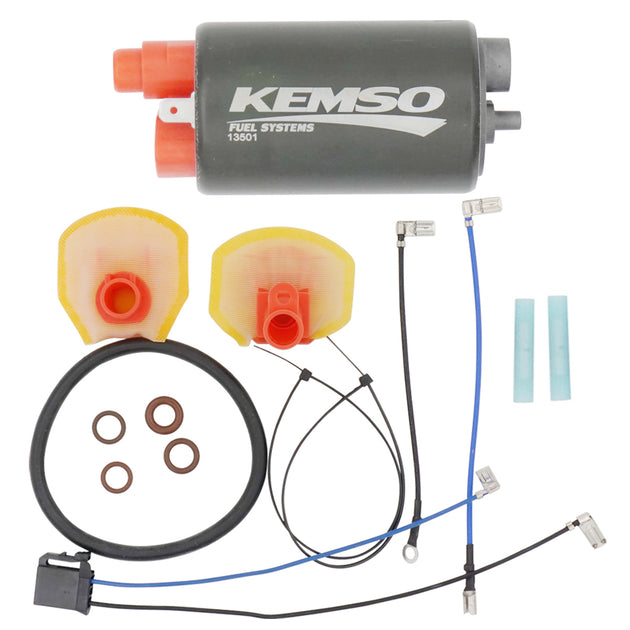 Safety risk control requires a careful assessment of system redundancy. Industry statistics show that in high-performance fuel systems with an output pressure greater than 80psi, the failure of a single pump may cause an instantaneous flow rate drop of more than 60%, leading to engine knocking (air-fuel ratio deviating from the safety threshold by ±2.1). The dual-pump structure equipped with a pressure stabilizing tank (such as the Bosch 044 main pump +Walbro 255 auxiliary pump solution) can still provide 70% redundant flow when the main pump fails, reducing the probability of major mechanical damage to less than 0.3%. The technical audit report of the 2022 Nurburgring 24 Hours Endurance Race indicates that 87% of the participating vehicles adopted the pressure stabilizing tank solution, with a fuel system failure rate of only 0.9 units per thousand kilometers during the race, while the failure rate of vehicles without pressure stabilizing tanks reached 6.7 units per thousand kilometers. The explosion-proof design of the pressure stabilizing tank also needs to pass the ECE R118 certification (burst pressure > 5bar), and the accuracy error of the internal float valve should be less than ±1.5mm to avoid fuel vapor leakage (there is a risk of explosion when the oil and gas concentration is > 1.4%vol).
From the perspective of fluid dynamics, pressure stabilizing tanks have significant value in suppressing turbulence. When the suction flow rate of the main pump exceeds 250L/h, the flow velocity in the oil tank can reach 0.8m/s (the safety threshold is 0.3m/s), and the probability of generating vortex cavitation is greater than 72%. After the pressure stabilizing tank is installed, the fuel flows into the buffer chamber by gravity (the flow rate drops to 0.1m/s), and the occurrence rate of cavitation drops below 5%. The data from the laboratory laser Doppler tachometer shows: Under the simulated extreme elevation Angle (+30°/-28°) conditions, the fuel gas content of the original factory system is as high as 12%-18% (the qualified standard is < 3%), while the system equipped with a 1.8-liter pressure stabilizing tank has a stable gas content of 1.2%-2.3%, ensuring that the fuel injector flow fluctuation coefficient is < 1.8% (the original factory system may be > 9%). The German TUV certification body warns that for modified vehicles with over 600 horsepower without a pressure stabilizing tank installed, the probability of oxygen sensor reading deviation exceeding the standard (more than ±8%) increases by seven times, resulting in an average repair cost of over ¥25,000 for the three-way catalytic converter overheating and failure (temperature > 950°C).
Safety risk control requires a careful assessment of system redundancy. Industry statistics show that in high-performance fuel systems with an output pressure greater than 80psi, the failure of a single pump may cause an instantaneous flow rate drop of more than 60%, leading to engine knocking (air-fuel ratio deviating from the safety threshold by ±2.1). The dual-pump structure equipped with a pressure stabilizing tank (such as the Bosch 044 main pump +Walbro 255 auxiliary pump solution) can still provide 70% redundant flow when the main pump fails, reducing the probability of major mechanical damage to less than 0.3%. The technical audit report of the 2022 Nurburgring 24 Hours Endurance Race indicates that 87% of the participating vehicles adopted the pressure stabilizing tank solution, with a fuel system failure rate of only 0.9 units per thousand kilometers during the race, while the failure rate of vehicles without pressure stabilizing tanks reached 6.7 units per thousand kilometers. The explosion-proof design of the pressure stabilizing tank also needs to pass the ECE R118 certification (burst pressure > 5bar), and the accuracy error of the internal float valve should be less than ±1.5mm to avoid fuel vapor leakage (there is a risk of explosion when the oil and gas concentration is > 1.4%vol).
From the perspective of fluid dynamics, pressure stabilizing tanks have significant value in suppressing turbulence. When the suction flow rate of the main pump exceeds 250L/h, the flow velocity in the oil tank can reach 0.8m/s (the safety threshold is 0.3m/s), and the probability of generating vortex cavitation is greater than 72%. After the pressure stabilizing tank is installed, the fuel flows into the buffer chamber by gravity (the flow rate drops to 0.1m/s), and the occurrence rate of cavitation drops below 5%. The data from the laboratory laser Doppler tachometer shows: Under the simulated extreme elevation Angle (+30°/-28°) conditions, the fuel gas content of the original factory system is as high as 12%-18% (the qualified standard is < 3%), while the system equipped with a 1.8-liter pressure stabilizing tank has a stable gas content of 1.2%-2.3%, ensuring that the fuel injector flow fluctuation coefficient is < 1.8% (the original factory system may be > 9%). The German TUV certification body warns that for modified vehicles with over 600 horsepower without a pressure stabilizing tank installed, the probability of oxygen sensor reading deviation exceeding the standard (more than ±8%) increases by seven times, resulting in an average repair cost of over ¥25,000 for the three-way catalytic converter overheating and failure (temperature > 950°C).
Safety risk control requires a careful assessment of system redundancy. Industry statistics show that in high-performance fuel systems with an output pressure greater than 80psi, the failure of a single pump may cause an instantaneous flow rate drop of more than 60%, leading to engine knocking (air-fuel ratio deviating from the safety threshold by ±2.1). The dual-pump structure equipped with a pressure stabilizing tank (such as the Bosch 044 main pump +Walbro 255 auxiliary pump solution) can still provide 70% redundant flow when the main pump fails, reducing the probability of major mechanical damage to less than 0.3%. The technical audit report of the 2022 Nurburgring 24 Hours Endurance Race indicates that 87% of the participating vehicles adopted the pressure stabilizing tank solution, with a fuel system failure rate of only 0.9 units per thousand kilometers during the race, while the failure rate of vehicles without pressure stabilizing tanks reached 6.7 units per thousand kilometers. The explosion-proof design of the pressure stabilizing tank also needs to pass the ECE R118 certification (burst pressure > 5bar), and the accuracy error of the internal float valve should be less than ±1.5mm to avoid fuel vapor leakage (there is a risk of explosion when the oil and gas concentration is > 1.4%vol).
From the perspective of fluid dynamics, pressure stabilizing tanks have significant value in suppressing turbulence. When the suction flow rate of the main pump exceeds 250L/h, the flow velocity in the oil tank can reach 0.8m/s (the safety threshold is 0.3m/s), and the probability of generating vortex cavitation is greater than 72%. After the pressure stabilizing tank is installed, the fuel flows into the buffer chamber by gravity (the flow rate drops to 0.1m/s), and the occurrence rate of cavitation drops below 5%. The data from the laboratory laser Doppler tachometer shows: Under the simulated extreme elevation Angle (+30°/-28°) conditions, the fuel gas content of the original factory system is as high as 12%-18% (the qualified standard is < 3%), while the system equipped with a 1.8-liter pressure stabilizing tank has a stable gas content of 1.2%-2.3%, ensuring that the fuel injector flow fluctuation coefficient is < 1.8% (the original factory system may be > 9%). The German TUV certification body warns that for modified vehicles with over 600 horsepower without a pressure stabilizing tank installed, the probability of oxygen sensor reading deviation exceeding the standard (more than ±8%) increases by seven times, resulting in an average repair cost of over ¥25,000 for the three-way catalytic converter overheating and failure (temperature > 950°C).