The Formula Library Behind Your Brief: How Deep Is the R&D Really?
Every fragrance manufacturer has a library of formulas; the depth of the company is measured by what happens when your brief does not match anything in it. A stock accord adapted to your brief is development of a kind. Building a palette of raw materials and accords from scratch, then iterating sample rounds, is a different kind — and the difference is visible in the conversation.
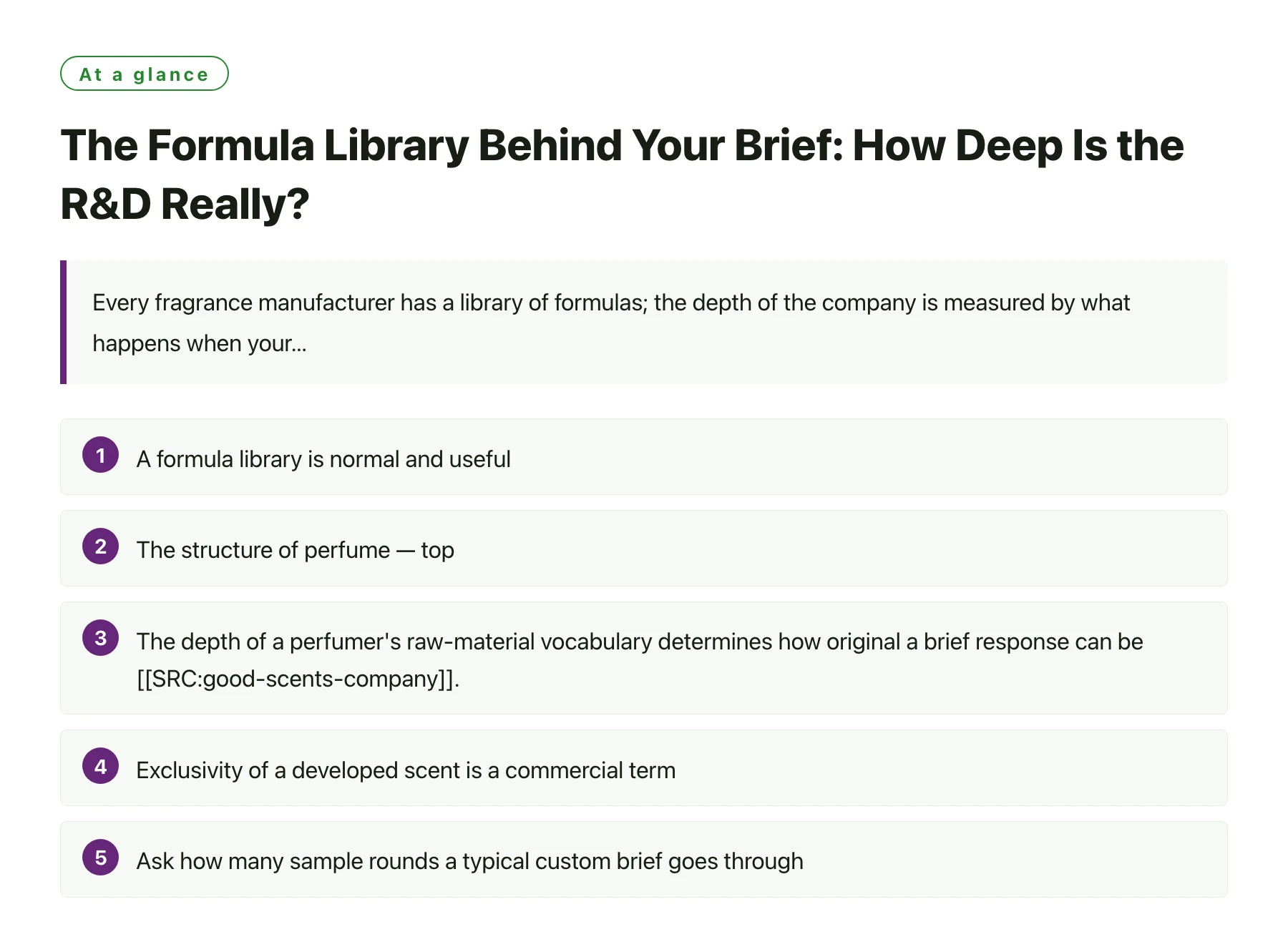
Key takeawaysA formula library is normal and useful; the question is whether the manufacturer can leave it when your brief demands something new. · The structure of perfume — top, heart and base notes built from a palette of materials — is what a developer works with when adapting or building an accord [1]. · The depth of a perfumer's raw-material vocabulary determines how original a brief response can be [2]. · Exclusivity of a developed scent is a commercial term, not an R&D one, and it has to be negotiated separately from the development work. · Ask how many sample rounds a typical custom brief goes through, and who actually does the compounding — that answer reveals where the R&D really lives.
When a buyer hears the phrase 'we have a large formula library', the instinct is to be impressed. The library is genuinely useful — it shortens lead times, lowers development cost and gives clients starting points — but it is storage, not capability.
Capability is what happens on the third sample round, when the client says 'closer, but less sweet, more mineral, softer trail'. This article explains how to tell whether a manufacturer will answer that request with craft or with a shrug.
What R&D depth actually is
R&D depth in a fragrance house is a combination of three things: raw material knowledge, compounding skill, and evaluation discipline. Raw material knowledge means the perfumer knows not only what an ingredient smells like at a dosage but how it behaves across concentrations and over time — and that knowledge is built on detailed, experience-tested records of individual materials [2].
Compounding skill is the ability to turn a verbal brief into a balanced formula, adjusting proportions and materials until the accord reads the way the client described it. Evaluation discipline is the habit of testing on skin, over hours, against references, rather than on a sniff of a blotter.
All three are invisible in a brochure and obvious in a conversation. Ask the perfumer who would handle your brief how they would approach a constraint you care about — a limited ingredient list, a difficult performance requirement, a price ceiling. The specificity of the answer is the R&D demo.
Library work versus development work
A library adaptation starts from an existing accord and makes targeted changes. It is fast, predictable and usually cheaper — and for many briefs it is the right answer. Full development starts from a palette, builds new accords deliberately, deconstructs the result over several rounds, and costs both more time and more money.
Neither is better. What matters is that the model is stated honestly and priced honestly, so a brand knows whether it is renting a formula or commissioning one. Raw material houses that supply the industry publish their own programmes for perfumery materials, which is a reminder of how much care sits behind even a single ingredient [3].
Library adaptation versus full development
| Dimension | Library adaptation | Full development |
|---|---|---|
| Starting point | An existing accord close to the brief | A palette of materials and accords |
| Time to first sample | Short | Longer |
| Cost | Lower | Higher |
| Originality ceiling | Bounded by the source accord | Only bounded by the palette and skill |
| Exclusivity | Rarely negotiable | Usually purchasable as a term |
| Best fit | Testing a category or price point quickly | A signature scent that has to be unique |
A good manufacturer will tell you honestly which lane your brief belongs in. Suspect the one that always answers 'full development' at library prices, or the one that always steers you to the library regardless of what you asked for.
Questions that reveal the R&D floor
Ask who will compound your samples and what training they have. In many factories the perfumer and the compounder are different people, and the distance between them decides how faithfully your approved sample gets reproduced at volume. A house that keeps development and production close, as one-stop manufacturers do, tends to lose less between the sample round and the bulk run.
Ask how the company briefs its own perfumers and how sample rounds are structured — whether each round comes with written evaluation notes and references, or with a fresh guess. Iteration discipline is the strongest predictor of a usable final sample.[2]
A manufacturer that builds custom scents for its clients — the model behind a manufacturer that builds custom scents — is used to being asked about iteration, exclusivity and ownership. When you go deeper into the full ODM fragrance service model, the same questions apply: who owns the developed formula, what happens to it when the project ends, and what exclusivity costs.
Finally, look at how the company talks about its own heritage. A fragrance house that has spent decades compounding, such as Xuelei fragrance brand with its stated 31 years in the industry, has had time to build the palette and the habits that depth requires. Verify the claim with what you see in the samples — and with the people who actually handle your brief.
The one question that summarises R&D depth: 'If I send you a brief that matches nothing you have, what happens?' A shallow house answers with hesitation or a suggestion to look at the catalogue. A deep house answers with a plan — palette, rounds, timing, cost, and who does the work.
Sources
- Wikipedia: Perfume —— An encyclopaedic overview of perfume covering definitions, history, the note structure of a fragrance and concentration terminology (background reference only).
- The Good Scents Company —— A reference database of aroma materials with odour descriptions, CAS numbers and typical usage information.
- Givaudan —— One of the largest fragrance and flavour houses; public material on fragrance creation, ingredient portfolio and market segments.
Frequently asked questions
Is a big formula library a sign of a good fragrance manufacturer?
It is a sign of experience, and useful for speed and cost. But depth is shown by the ability to develop beyond the library, so ask what happens when your brief matches nothing on the shelf.
How many sample rounds is normal for a custom scent?
Three to five is common before approval, depending on how clearly the brief was written and how strict the performance requirements are. The number matters less than whether each round comes with structured feedback.
Should I ask for exclusivity on a developed scent?
If the scent is your differentiator, yes — but treat it as a commercial term with a price, negotiated and written down, because without it the starting formula may be offered to other clients.
Who owns the formula after a custom development project?
It depends on the agreement, and that is the point: ownership should be a written term. Confirm whether you receive the full formula, whether the house keeps it on file, and what happens if you change manufacturers.
How do I evaluate a perfumer's skill without being a perfumer myself?
Compare. Brief the same constraint to two manufacturers, then compare the interpretations blind. Skill shows up as coherence — the samples answer the brief, and the feedback rounds move deliberately toward it.