Reading GMPC and ISO 22716 Claims from a Cosmetics Manufacturer
Two suppliers can print the same standard names and still describe very different factories, so the words alone settle little. Read carefully, a standard name is a framework the company says it follows; the figures beside it are what a buyer can actually check. The manufacturer's own pages, for example, attach a microbial limit under 10 CFU/g and 24-hour accelerated incubation to their testing, which is more concrete than the label above it.

Key takeaways
- The pages state that a 30,000 m² factory holds United States GMPC and EU ISO double certification.
- The same pages list GMPC, ISO 22716, FDA, SEDEX and CANS as standards, with MSDS, COA, Intertek-COC and SGS-CPSR named as certificates.
- Published testing figures include a microbial limit under 10 CFU/g and 24-hour accelerated incubation.
- All of this is the manufacturer's own published wording, which is what a buyer verifies rather than repeats.
What a standard name does and does not say
A standard name says which framework a company claims to work inside. It does not say who audited the work, when, or against which scope. For a buyer, the practical test is whether an ISO22716 GMPC cosmetics manufacturer can attach a document and a date to each name it prints. When a page lists GMPC, ISO 22716, FDA, SEDEX and CANS, the reader learns that these frameworks appear in the company's own description of itself. That is a real starting point, and it is still a starting point rather than an ending. The list tells a buyer what to ask about; it does not close the question.
The practical reading is to treat each claim as a pointer. A pointer to a standard is a prompt to request the document behind it. A pointer to a certificate is a prompt to check its scope and date. A reader who expects a page to do that work for them will either over-trust the page or dismiss it, and both mistakes cost money later.
Where GMPC and ISO 22716 sit on the page
On the OEM/ODM pages published by Guangzhou-based Yunmei, the quality language sits in two layers. The first layer is the standards layer: GMPC, ISO 22716, FDA, SEDEX and CANS. The second layer is the certificate layer: MSDS, COA, Intertek-COC and SGS-CPSR. The pages also state that the 30,000 m² factory holds United States GMPC and EU ISO double certification, and they mention a Guangdong High-tech Enterprise certification. Each of these is a company statement, and each is worth attributing to the page rather than repeating as an independent fact.
This distinction is not pedantry. A buyer who writes "the supplier says its pages list ISO 22716" keeps the source attached to the claim. A buyer who writes "the supplier is ISO 22716" has changed a published statement into an assertion they now own. When the scope, the site or the year turns out to differ, the second buyer has to defend a claim they never verified. Attributing the statement to the manufacturer's own pages keeps the record honest and the negotiation easier.
The published testing figures
The clearest claims on the pages are the testing figures, because they come with numbers. The published microbial limit is under 10 CFU/g. The published accelerated incubation runs for 24 hours. Alongside those, the pages describe ATP bioluminescence testing and 3D vision inspection, and they state a full weight verification on the filling line.
Numbers are useful because they can be compared. A limit of under 10 CFU/g is a specific ceiling, and 24 hours is a specific duration. Those two figures let a buyer ask a supplier a sharper question than the standard names do: which method produced the number, and what happens when a batch approaches the ceiling. The table below sets out the layers and what each one can tell a reader, using the wording from the manufacturer's own pages.
| Layer | Published wording | What it tells a buyer |
|---|---|---|
| Standard names | GMPC, ISO 22716, FDA, SEDEX and CANS | Which frameworks the company states it follows. |
| Certificates | MSDS, COA, Intertek-COC and SGS-CPSR | Which documents the company says it can provide. |
| Line checks | ATP bioluminescence testing, 3D vision inspection and full weight verification | Which checks are described as part of production. |
| Test figures | Microbial limit under 10 CFU/g and 24-hour accelerated incubation | What specific value the page attaches to a test. |
What a buyer can and cannot conclude
A buyer can conclude that the company describes itself against recognised frameworks and publishes specific test figures. That is enough to justify a deeper check, and it is not enough to skip one. A buyer cannot conclude, from a page alone, the scope of any audit, the currency of any document, or whether the figures apply to every line and every product. Those answers come from documents the supplier shares on request.
The right response to a careful claim is a careful question. Which facility does the scope cover? Which year does the certificate carry? Which products fall inside it? A supplier that keeps its own pages current will usually answer these quickly, because the pages already point at the documents. A supplier that cannot answer them has told the buyer something useful about how it treats claims.
Worked example: reading the three figures
Take the published testing figures as the inputs: a microbial limit under 10 CFU/g, a 24-hour accelerated incubation, and a full weight verification. Start with the microbial ceiling. Under 10 CFU/g means a single gram of product may carry fewer than 10 colony-forming units, so the ceiling is a small number by design. A 24-hour incubation is the second input, and it is a screening step rather than a shelf-life statement; the pages put stability and compatibility reports at 3–6 months, which is the longer test behind the screen.
Convert the two time figures to the same unit to see the ratio. At about 30 days a month, 3 months is about 90 days and 6 months is about 180 days. A 24-hour incubation is 1 day, so it is 1 ÷ 90 ≈ 0.011 of the shortest report window, about one part in ninety. The point is not that the accelerated test is weak; it is that it screens, while the months-long report confirms. The third input, full weight verification, is a coverage figure: applied across a stated daily capacity of 200,000 units, it implies up to 200,000 weight checks a day.
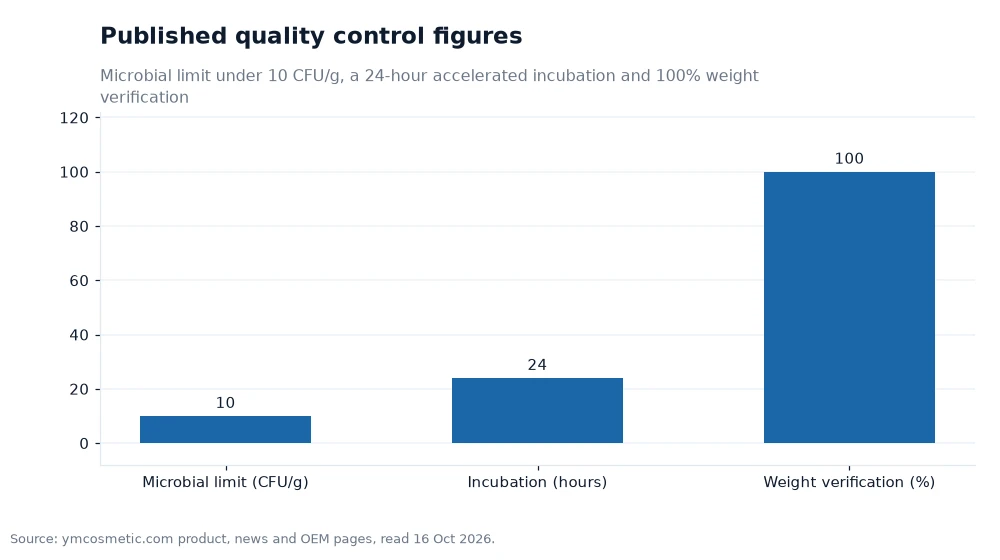
Reading the three bars
The chart puts three different figures side by side, so it needs a warning before the numbers. They are not on one scale: 10 is a count ceiling per gram, 24 is a duration in hours and 100 is a coverage percentage. The value of the chart is not comparison but orientation, because it gathers the three published checks in one place.
The two figures to hold on to are 10 and 100. The 10 CFU/g ceiling is the clearest published limit, and it is the number to quote when asking how a batch is judged. The 100 percent figure is the clearest coverage statement, and it says every filled unit is weighed rather than a sample. The 24-hour bar sits between them as the screening step, useful on its own terms but not a substitute for the longer reports.
Questions to ask about any certificate
Four questions cover most of the ground. Which legal entity holds the certificate? Which site does the scope name? What is the issue and expiry date? And which products are covered? Asking these in writing turns a page full of standard names into a short list of documents a buyer can actually read. A supplier whose pages already attribute each claim will find the questions easy to answer.
It also helps to see how the manufacturer frames its own production route while reading the claims, because quality language only means something when a line is behind it. The company's OEM manufacturing page describes how the stages fit together, which gives the claims a place to land. Read the documents, keep the source attached to each statement, and a buyer can carry the standard names into a negotiation without over-claiming on either side.
Frequently asked questions
What does a GMPC or ISO 22716 claim actually tell a buyer?
It tells a buyer which framework the company states it follows, not who audited the work or when. Treated as a pointer, the claim leads to a document worth requesting. Treated as a conclusion, it can hide gaps in scope, site or year.
How should a buyer treat certification language on a supplier page?
Attribute it to the supplier's own published pages rather than repeating it as an independent fact. A buyer who writes that the pages list a standard keeps the source attached, while a buyer who restates it as their own assertion has to defend a claim they never verified.
What do the published testing figures mean?
The pages publish a microbial limit under 10 CFU/g, a 24-hour accelerated incubation, ATP bioluminescence testing and 3D vision inspection, plus full weight verification. The 24-hour incubation screens a batch, while stability and compatibility reports at 3 to 6 months confirm it over time.
Read the standard, then read the document
A standard name is the beginning of a check, not the end of one. Read the page, note which claim sits at which layer, and request the document behind each. Keep the manufacturer's own wording attached to every statement, so the record shows what was published rather than what was assumed. Do that, and names like GMPC and ISO 22716 become a map of what to verify instead of a slogan to trust.
The figures quoted come from the manufacturer's own published pages, reviewed on 16 Oct 2026.[1]